
Polyaspartic vs Epoxy: Which Is Better for a Florida Garage Floor?
For most Central Florida garages, polyaspartic is the better call. Data sheets list it as UV-stable, so it holds its color where sun hits the floor. It also cures faster, so you get the garage back sooner. Epoxy costs less per square foot in national cost guides, and it fits floors that stay out of the sun.
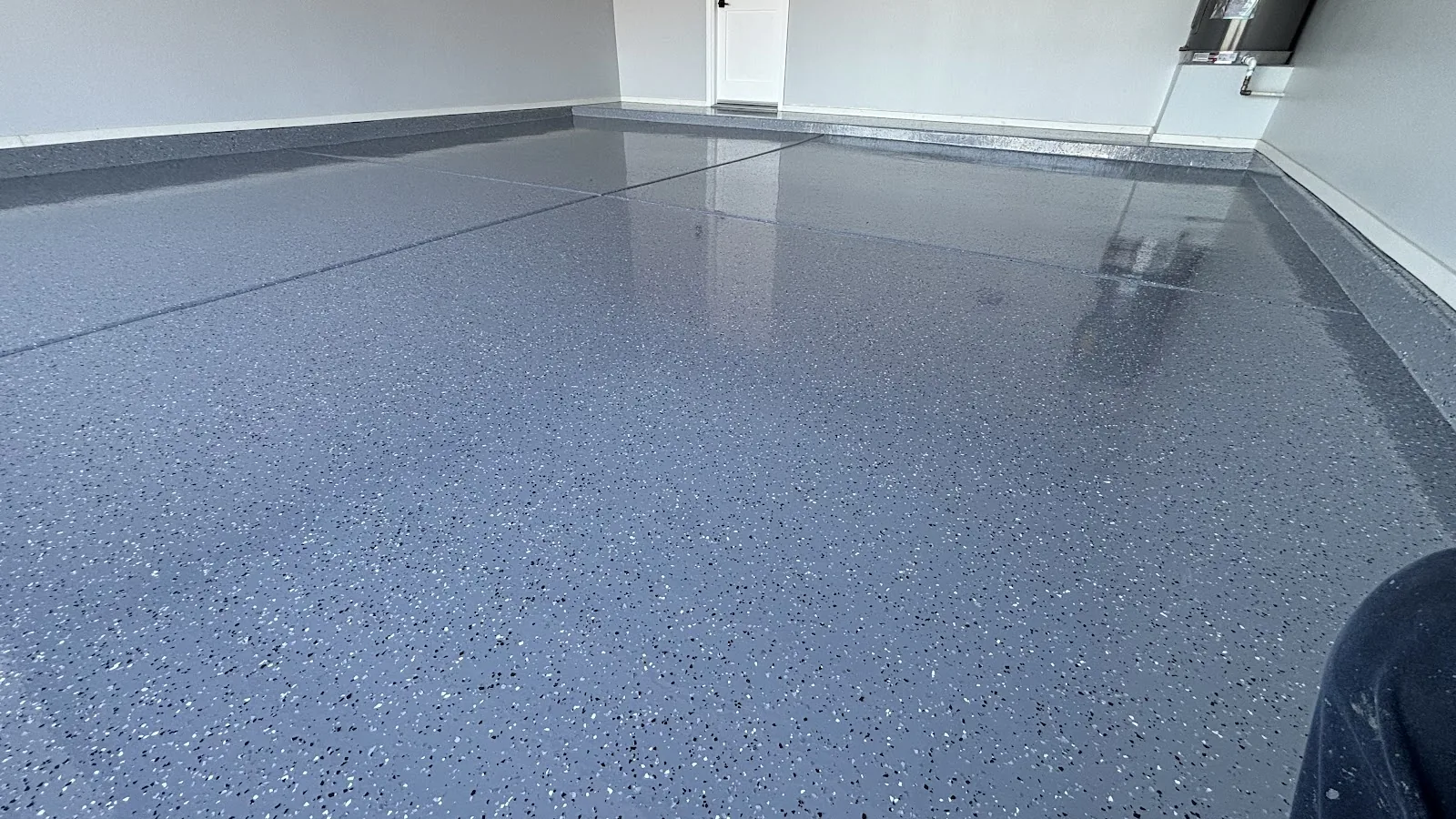
Polyaspartic floor coatings with a full flake broadcast are the main garage floor system at Armor Garage Flooring. Our epoxy system with a sand finish goes on shop floors and other interior slabs. Either way, we grind the concrete first. Both coatings need clean, open pores to bond.
How do polyaspartic and epoxy compare side by side?
Each figure in this table comes from one product’s data sheet or one national cost guide. Products vary, so the schedule for your floor comes from the coating manufacturer.
| Factor | Polyaspartic | Epoxy |
|---|---|---|
| Cure time | Foot traffic in about 3 to 12 hours; full cure in 1 to 7 days | Foot traffic in 12 to 24 hours; full cure in 5 to 7 days |
| UV yellowing | UV-stable; sheets list it as resisting yellowing | Not UV color stable; it can yellow and fade in sun |
| Heat and humidity during install | About 10 to 30 minutes of working time, less in heat; slab at least 5 degrees above the dew point | About 45 minutes of working time in one sheet; the same dew point rule |
| Hot tire pickup | Comes down to the bond with ground, clean concrete | Same rule; a resin maker ties pickup on epoxy floors to poor prep |
| Thickness | Thin coats: one sheet calls for 5 to 6 mils wet, 10 at most; one full flake system totals 35 to 50 mils | Thicker coats: one sheet gives coverage for 8 to 20 mils; its two-coat system is about 20 mils |
| Market cost, installed | $5 to $12 per square foot in one national guide; $4 to $9 in another | $4 to $10 per square foot in the first guide; $3 to $12 in two others |
How fast does each one cure?
Polyaspartic is faster. Its data sheets allow light foot traffic after about 3 to 12 hours. Cars follow after about a day on some products and up to a week on others. Epoxy data sheets put foot traffic at 12 to 24 hours and full cure at 5 to 7 days.
A national cost guide gives polyaspartic 1 to 2 days to fully cure, and epoxy up to a week. A 2020 trade column puts a polyaspartic garage floor at about 5 hours, start to finish. It says an epoxy floor typically takes 5 days. Weather moves all of these times.
Will epoxy turn yellow in the Florida sun?
It can. One epoxy data sheet says its product is not UV color stable. A UV-inhibited epoxy’s sheet still warns of chalking and fading with long sun exposure. Another epoxy sheet says a urethane topcoat slows the yellowing.
Polyaspartic sheets list their coatings as UV-stable, with long-term color and gloss retention. That matters in a Florida garage with the door open to afternoon sun. One epoxy sheet also calls its product not suited for exterior use.
How do Florida heat and humidity change install day?
Heat shortens working time. One polyaspartic sheet gives about 20 to 30 minutes once mixed at 77 degrees, and much less over 90. Epoxy gives more time, about 45 minutes in one sheet, but that sheet tops out at 86 degrees. NOAA normals give Lakeland about 119 days a year at 90 degrees or more.
Humidity matters through the dew point. Sheets for both systems want the slab at least 5 degrees warmer than the dew point. Summer dew points across Central Florida run in the low 70s. So the slab temperature gets checked before any coat goes down.
Moisture also rises from below. On about half of Lakeland’s land, NRCS soil data put the water table within 18 inches of the surface. That happens for part of the year, mostly in the June to September rains. A trade column reports polyaspartic floors failing over slabs that gave off too much moisture.
Epoxy needs a dry slab too, and coating makers generally require a moisture test first. When the reading runs high, a moisture-blocking primer goes down before the coating.
Which one resists hot tire pickup better?
The bond to the concrete decides it, for both systems. Hot tire pickup starts when tires, hot from a drive, cool on the floor and pull the coating up. A resin flooring maker’s help page describes it on epoxy floors. It blames poor prep, such as the wrong primer or skipped grinding.
We grind the concrete before either system, and our floors are made to resist hot tire pickup. Tire oils can soak into bare concrete, sometimes deeper than grinding reaches. Sheets for both systems also warn that tire plasticizers can stain a finish. Staining is a separate problem from pickup.
Which one goes on thicker?
Epoxy usually goes on thicker per coat. A trade column notes that epoxy is much thicker as a liquid, while polyaspartic flows like water. One epoxy sheet gives coverage for coats of 8 to 20 mils (thousandths of an inch). One polyaspartic sheet calls for 5 to 6 mils wet and caps a coat at 10.
The finished floor depends on the system. A full flake system builds up in layers of coating and flake. One polyaspartic flake system sheet lists 35 to 50 mils in all. The same sheet claims more surface hardness than epoxy flake systems.
How much more does polyaspartic cost?
Somewhat more, in the national cost guides. One guide prices both: polyaspartic at $5 to $12 per square foot installed, and epoxy at $4 to $10. For a two-car garage, it uses 400 to 576 square feet. There, polyaspartic runs $2,000 to $6,900, and epoxy runs $1,600 to $5,800.
A second guide prices polyaspartic at $4 to $9 per square foot. These are market numbers, not our price list. Prep, cracks to fill, moisture work and flake coverage all move the price. Our guide to garage floor coating costs in Florida breaks down the full ranges.
When is each one the right call for a Central Florida garage?
Polyaspartic fits most home garages here. Pick it when the door opens to sun or when you want the car back inside sooner. It is also the base for our full flake finish, with color chips broadcast over the whole floor.
Epoxy fits floors that stay out of the sun, like a workshop or a utility room. It costs less per square foot in the guides. Our epoxy floor coatings end in a sand finish for grip. A shaded garage that works as a shop can take epoxy too.
Which system fits your garage?
That depends on how much sun your floor gets and how soon you need it back. Our page on the polyaspartic garage floor system covers each step of the install. We work across Polk County and the Four Corners side of Central Florida. For a free estimate on your own floor, call or text (866) 282-7667.