
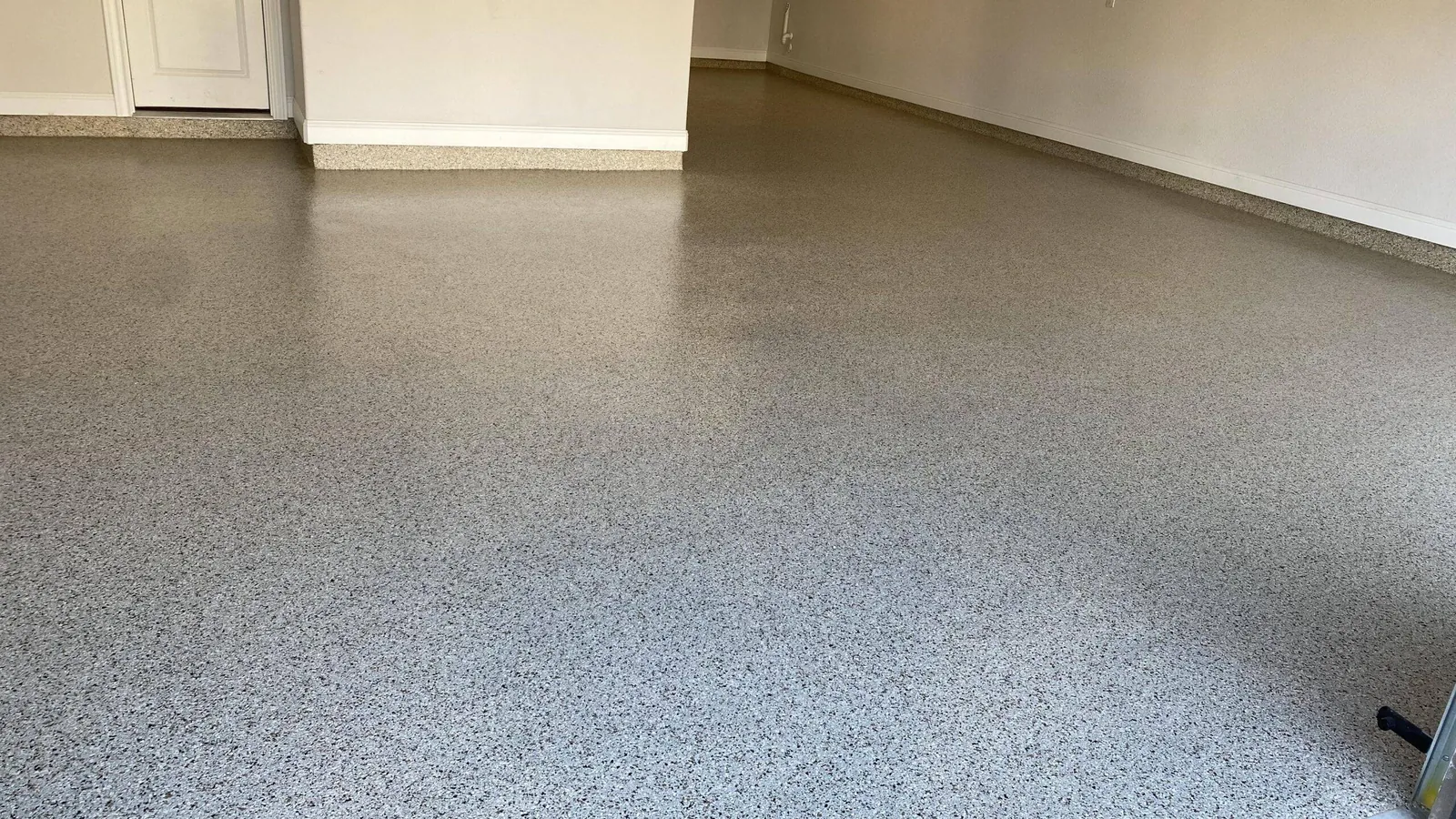
Garage Floor Tiles vs Epoxy: Which Is Better for a Florida Garage?
For most homeowners who plan to stay in their home, a coated floor is the better garage floor. It bonds to ground concrete and leaves no seams. Interlocking tiles make more sense for a do-it-yourself floor you may want to pull up later. Laid yourself, they often cost less up front.
In this guide, epoxy stands for any coated garage floor. A national cost guide names epoxy, polyurea and polyaspartic as the three most common types of garage floor coatings. Tiles work another way: they snap together and sit on top of the slab. Our garage floor coatings page shows how a coated floor goes in.
How does each floor go down?
Tiles go down fast. One tile maker says its tiles install in hours. Its guide says to let the tiles sit at room temperature, 72 degrees or higher, for 24 hours first. A home-improvement cost guide sums up the job: snap the pieces together and trim edges around obstacles.
A coating takes more steps. We grind the concrete first, then lay down a base coat. In our two full broadcast packages, flake covers the whole base coat, and a clear polyaspartic topcoat goes on last. Our flake floor coating page walks through it.
Cure time depends on the coating. A national cost guide says polyaspartic can often be installed and fully cured within 1 day. The same guide says epoxy may take up to a week to cure.
What do garage floor tiles and epoxy cost?
In one national cost guide, tiles cost less up front when you lay them yourself. A home-improvement cost guide puts tiles higher.
| Interlocking tiles | Coated floor | |
|---|---|---|
| Per square foot, national cost guide | $2 to $5, installed yourself | $4 to $12, materials and installation |
| Two-car garage, same guide | $800 to $2,900, installed yourself | $1,600 to $6,900 |
| Average per square foot, home-improvement cost guide | $6.55 | $4.05 for an epoxy coating |
The two guides disagree on which one costs more. The first one prices tiles you install yourself against a coating with labor included. Ask what each quote covers before you compare.
These are market numbers, not our price list. For coating prices by system and garage size, see our guide to garage floor coating cost in Florida.
Which one holds up better to hot tires and oil?
Coatings have one well-known failure: hot tire pickup. Tires warm from a drive expand and contract on the floor, then grip it and can peel it up. A resin flooring maker’s help page ties this to poor prep, such as the wrong primer or skipped grinding. We grind the concrete before any coat goes down.
Tiles do not bond to the slab, so their weak spot is movement. The home-improvement cost guide lists “material can shift and separate” as a tile minus. It also calls tiles impact-absorbing and an epoxy coating chemical-proof.
Our coated floors are made to resist impacts, stains, chemicals and hot tire pickup. On lifespan, the home-improvement guide gives tiles 10 to 20 years and an epoxy coating 5 to 15 years. The national cost guide lists 3 to 20 years for epoxy and 10 to 20 years or more for polyaspartic. The type of coating matters as much as the choice between tiles and a coating.
How do Florida heat and slab moisture affect each floor?
Heat makes tiles expand. One tile maker’s guide calls for a gap at the walls and at fixed objects. The minimum is a quarter inch for some styles and a half inch for others.
The same guide says an open garage door and varying temperatures may affect the floor. It suggests laying the front-of-garage tiles in the sun before install, so they expand first.
In the sun, the home-improvement guide says an epoxy coating can fade. A national cost guide says polyaspartic floors resist yellowing from UV exposure. Both of our full broadcast packages finish with a clear polyaspartic topcoat. That choice has its own guide: polyaspartic vs epoxy garage floors.
Moisture is the other Florida issue. A national cost guide lists “may trap moisture” as a tile minus. It also says epoxy cannot bond properly when wet or exposed to high humidity. Pros may need to run moisture tests before coating, the guide adds. Our Armor Signature package uses a hybrid epoxy/polyurea system that provides moisture mitigation.
If storm water ever gets into the garage, tiles can be removed to reach the slab. A coated floor gets cleaned in place.
Which one is easier to clean?
A coated floor has no seams to hold dirt. The home-improvement guide lists easy cleanup as an epoxy plus. It also suggests an epoxy coating to protect a floor from oil and gas staining.
Tiles take more work at the seams. The same guide’s upkeep table says to deep scrub tile seams yearly and realign shifted sections. For epoxy, it says to recoat high-traffic spots every 3 to 5 years.
How do tiles and a coated floor compare on looks?
Tiles offer customizable patterns, a national cost guide notes. A coated floor gets its look from the flake blend under the clear topcoat. You can see our flake colors before you choose.
Can you install either one yourself?
Tiles are the DIY pick. A national cost guide lists easy DIY installation as a tile plus. The home-improvement guide says interlocking tiles and basic single-coat epoxy systems suit DIY installs. Edge pieces need cutting, and one tile maker names a circular saw or a jig saw for the job.
A full flake system is a bigger job. A national cost guide lists “requires professional installation” as a coating minus. Grinding comes first, and the coats leave short working windows. One polyaspartic data sheet gives about 10 to 15 minutes of usable working time.
We install coated floors. If you choose tiles, the maker’s installation guide is the one to follow.
Which floor fits your garage?
Choose tiles for a DIY floor you can lift later. Choose a coating for a floor that bonds to the slab and wipes clean. On a Florida slab, check for moisture first either way.
Our polyaspartic floor coating page covers the topcoat, and our garage floor coatings page covers the whole job. We serve Polk County and the Four Corners side of Central Florida. For a free estimate on your floor, call or text (866) 282-7667.